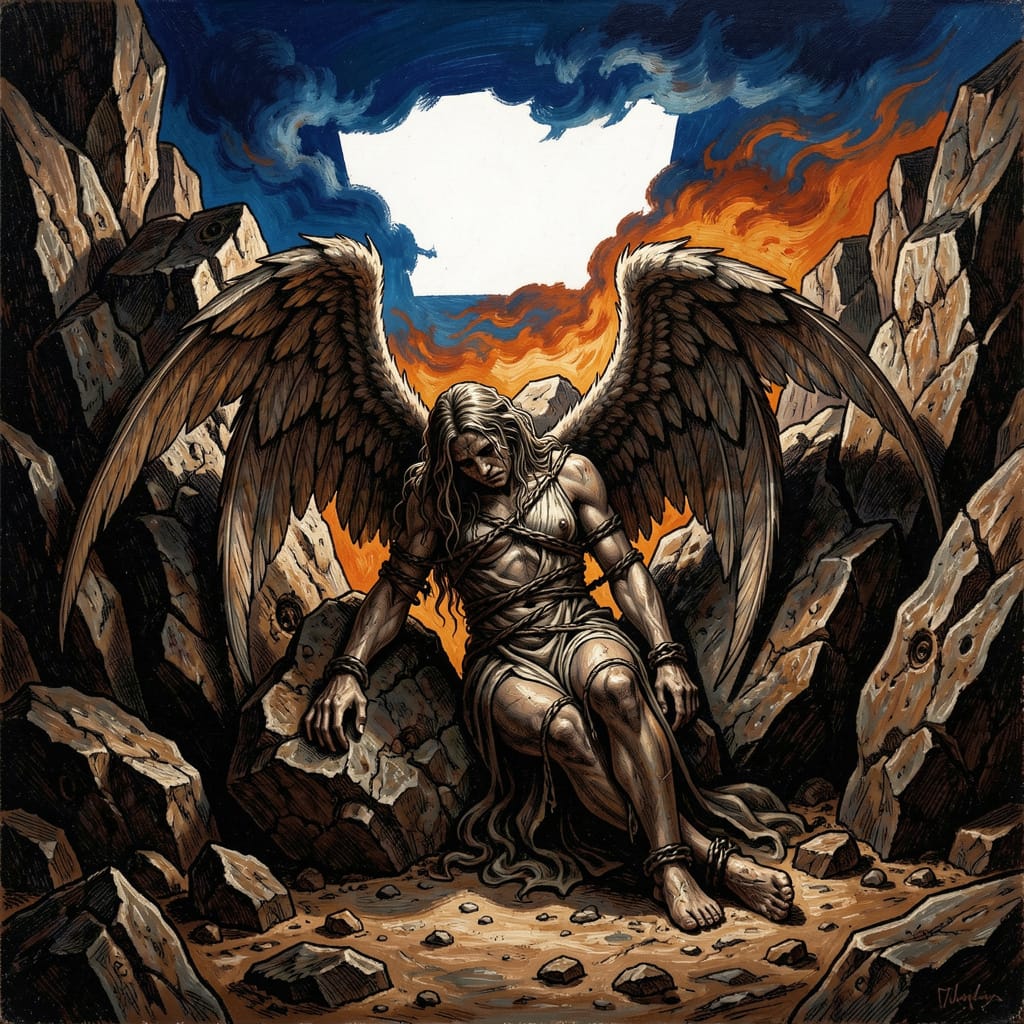
Azazel's earliest appearance is in the Yom Kippur ritual of Leviticus 16. Two goats are chosen: one for Yahweh, to be sacrificed, and one la-azazel — for Azazel — upon whose head the sins of the people are laid, and which is then driven out into the wilderness to bear them away. The scapegoat carries the community's guilt not into destruction but somewhere — to Azazel. It is one of the oldest acknowledgements in any religious tradition that the forces requiring propitiation include something other than the divine.
In the Book of Enoch the figure becomes explicit and terrible. Azazel is one of the chief Watchers — the Grigori, the angels who descended to earth and took human wives. He taught men to make swords, knives, shields, and breastplates; he revealed the metals of the earth and the art of working them; he taught the use of cosmetics and the art of deception. Enoch 8 is precise: "The whole earth has been corrupted through the works that were taught by Azazel: to him ascribe all sin." Seeing the corruption, God commands the archangel Raphael to bind Azazel hand and foot and cast him into the darkness — into a ravine at Dudael, covered with jagged rocks, his face covered that he may not see the light, there to wait until the day of judgement, when he is to be cast into fire.
The Apocalypse of Abraham shows him in another form — an unclean bird, his angelic nature reduced to the remnant of a celestial garment now reassigned to another. He has been stripped of what he was. What remains is the fallen thing, the teacher of weapons, bound in the desert under the weight of what he enabled. In the classification the Seven follow, Azazel holds the office of Wrath — a divergence from Binsfeld's own attribution, which placed Satan at Wrath, reflecting the shifting of the roster across the ages.
The comparison most often drawn to Azazel is Prometheus — the Titan who stole fire from the gods and gave it to humanity, and was bound and tormented for it. The parallel is exact in structure: both bring forbidden knowledge from a higher register down to mortals; both are punished with binding and suffering; both are defined by what that knowledge enabled. The difference is only in the framing. Prometheus is remembered as benefactor, Azazel as corruptor — yet the knowledge is the same. What divides them is not the gift but the judgement passed upon it.
The parallel also marks the limit of the comparison. Prometheus gave one gift and was done; Azazel's teaching did not end with the swords and the breastplates of Enoch. The tradition treats him as the permanent tutor of human violence — each age's means of killing understood as the same lesson taught again in a new form, from the forge to the furnace to whatever comes after. He is bound at Dudael and yet never absent, because the knowledge outlived the teacher and needs no further instruction to spread.